
Reasons for White Spots on High-Alumina-Silica Glass Polished with White Fused Alumina
I. Problems with Abrasive (Most Common)
Hard agglomerated particles (frequent occurrence) Superfine white fused alumina powder absorbs moisture and agglomerates due to static electricity, forming hard agglomerates that cannot be dispersed. Insufficient dispersion of slurry causes agglomerated particles to press against the glass surface, resulting in localized over-cutting and discrete white spots. Under strong light, these appear as micro-pits or clusters of fine micro-scratches and cannot be wiped off. ✅ Selection requirement: Use low-sodium high-purity WFA specially for glass pre-polishing with dispersion treatment and no hard agglomerates. Ordinary white fused alumina (tilting furnace grade without dispersion treatment) is highly prone to this issue. ✅ Index threshold: Al₂O₃ ≥99.2%, Fe₂O₃ ≤0.03%, Na₂O ≤0.3%. White fused alumina with excessive sodium oxide is a major risk.
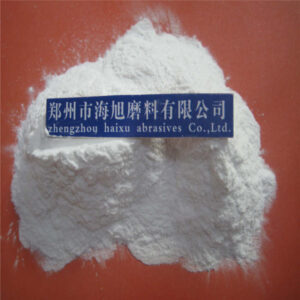
Key note: White fused alumina with excessive Na₂O tends to cause pH drift and agglomeration in aqueous polishing systems, and also induces weathering white spots on glass.
Poor particle size classification and contamination by oversized particles or residual SiC Insufficient cleaning after previous rough grinding with black silicon carbide, shared slurry tanks, and mixing of coarse SiC particles into white fused alumina slurry. Or poor classification of white fused alumina with excessive oversized particles, which create bright white spots under compression.
Sharp particle edges lead to subsurface microcracks (hidden white spots) White fused alumina has sharp angular grains. High-alumina-silica glass is brittle. The surface may look intact during polishing, but microcracks form in the subsurface. After cleaning, under strong light inspection or after storage, these cracks reflect light and appear as white spots or haze. 👉 This explains why white fused alumina is only suitable for pre-polishing instead of final mirror polishing. It can remove CNC tool marks but cannot repair subsurface damage. Switching to cerium oxide final polishing is required afterwards.
II. Slurry and Chemical System (Corrosion-Type White Spots, Often Misjudged as Abrasive Marks)
Ion precipitation and hydration corrosion white spots can still occur on high-alumina-silica glass: Non-pure water with calcium, magnesium ions and carbonates from tap water. Silica gel and hydroxide microcrystals precipitate on the glass surface after polishing and form watermark white spots that cannot be wiped off. These are chemical corrosion stains rather than abrasive scratches.
Uncontrolled slurry pH: White fused alumina is weakly alkaline. The pH keeps rising with long-term slurry circulation, and alkali attacks the surface of high-alumina-silica glass.