
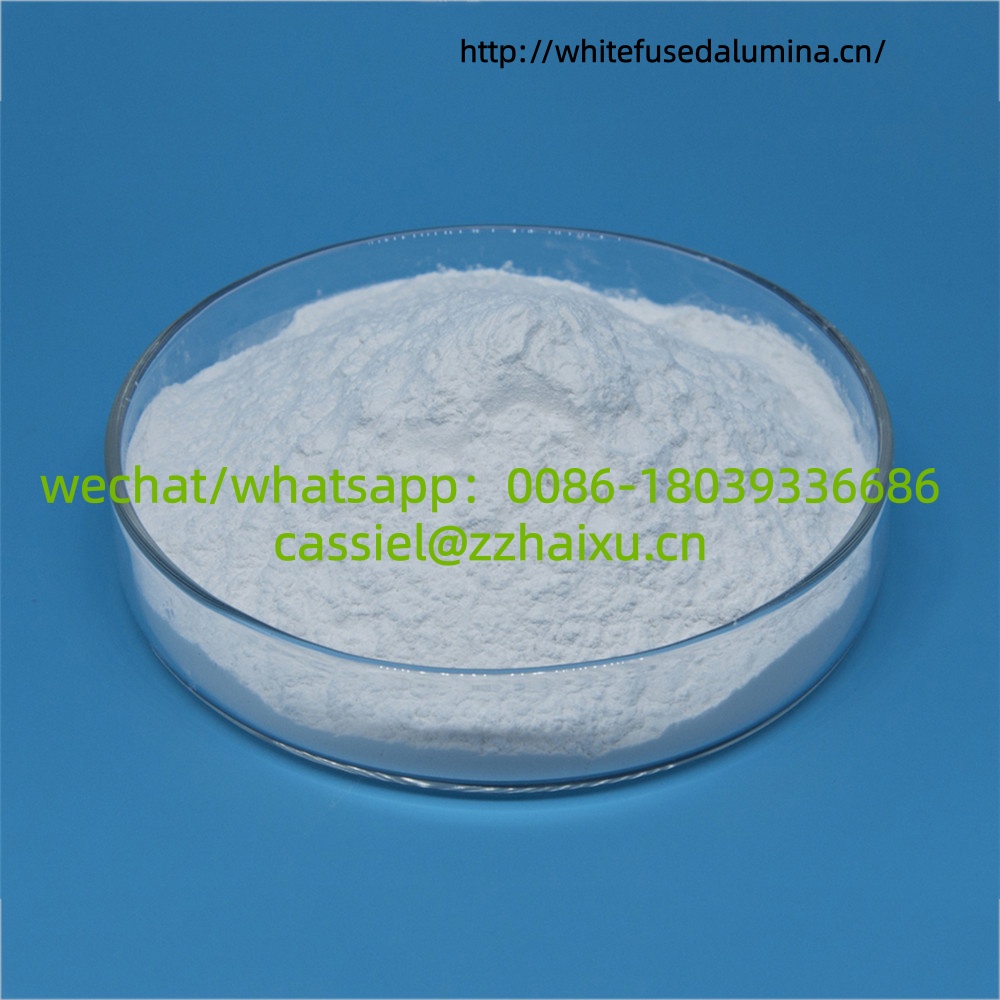
White Fused Alumina Slurry for Optical Lens Polishing
Positioning: White fused alumina polishing slurry is only used for fine grinding and pre-polishing after milling. It cannot achieve final mirror polishing; cerium oxide polishing slurry shall be adopted for the final mirror finishing.
Core Features: α‑Al₂O₃ with Mohs hardness 9, high cutting efficiency and chemical inertness. Major risks: scratches caused by coarse particles/hard agglomerates and subsurface damage (SSD) induced by excessive pressure, leading to fogging and pitting after coating.
I. Mandatory Specifications of White Fused Alumina Powder
| Item | Internal Control Standard | Notes |
|---|---|---|
| Al₂O₃ | ≥99.0%, preferably ≥99.3% | Electrically fused white corundum, α crystal phase; γ phase is forbidden due to insufficient hardness |
| Fe₂O₃ | ≤0.03%, max 0.05% | Excess iron directly causes yellow spots and rust marks, critical index for optical lenses |
| Na₂O | ≤0.4% | High sodium content tends to trigger agglomeration and poor slurry stability |
| Particle Morphology | Equant polyhedron; strictly limit long needle-shaped sharp particles | Sharp particles aggravate subsurface damage |
| Particle Size (W Series) | Fine grinding: W14, W10, W7Pre-polishing: W5, W3.5, W2.5 | Strictly control D99 to eliminate oversized tail particles; D50 means median particle size |
| Treatment Process | Acid washing + hydraulic classification + magnetic iron removal | Ordinary crushed material is not suitable for optical polishing slurry |
II. Basic Polishing Slurry Formula (Mass Fraction, Deionized Water System)
✅ Fine Grinding Slurry (W7~W14, for removing milling marks) White fused alumina powder: 20~25% Deionized water: 74.2~79.5% Sodium polyacrylate (PAA-Na dispersant): 0.3~0.6% pH adjuster (dilute ammonia water): adjust pH to 7.5~9.0 Optical grade low-foam defoamer: ≤0.05%
✅ Pre-polishing Slurry (W1.5~W5, between fine grinding and cerium oxide polishing) White fused alumina powder:10~15% Deionized water:84.4~89.7% Sodium polyacrylate:0.2~0.4% pH adjuster: maintain pH at 7.5~9.0 Defoamer: optional trace addition
Notes: When pH<7, alumina particles easily flocculate and agglomerate. When pH>10, slight corrosion occurs on K9/borosilicate glass and causes pitting. Do not overdose dispersant; excessive dispersant leads to heavy foaming and water stains on lenses.
III. Preparation Procedure
- Add deionized water into stirring tank, add dispersant and stir at low speed until fully dissolved, then add ammonia water to adjust pH value.
- Feed white fused alumina powder slowly in batches. Pouring large quantity at one time is forbidden to avoid agglomeration.
- High-speed stirring for 30–60 min. Horizontal sand milling is recommended for bulk production to break hard agglomerates; ultrasonic dispersion is available for small batches.
- Filtration: 800 mesh filter bag for fine grinding slurry; 1200~1500 mesh filter bag for pre-polishing slurry.
- Testing: solid content, pH, particle size distribution D50/D99, sedimentation stability. Conduct trial polishing with samples for verification.
- Storage: keep low-speed continuous stirring in storage tank. After sedimentation, re-stir and re-filter before use.
- Pipeline Material: PP/PE/316 stainless steel. Ordinary carbon steel pipeline is prohibited, as rust will induce yellow spots.