
White fused alumina have three major applications: sintering setter sand, grinding and polishing media, and epoxy encapsulation filler.
✅ Core Functions
MLCC laminated sintering setter sand (the most mainstream application)
Spread between setter plates and MLCC green chips: it separates and prevents sticking, provides point support, allows free shrinkage to avoid warpage, and facilitates gas ventilation. It will not contaminate dielectric layers or introduce leakage current and dielectric loss. It is an essential material for the MLCC kiln process.
Post-sintering grinding and tumbling powder for capacitor terminals / ceramic bodies
Used for chamfering, deburring and surface finishing after sintering. Oversized particles are strictly controlled to prevent scratches on dielectric layers and micro-short circuits.
Filler for epoxy encapsulation compound
Improves thermal conductivity, rigidity and temperature resistance of encapsulation compound, reduces thermal expansion coefficient, and enhances moisture resistance and voltage resistance.
Specification Requirements (Low-sodium grade preferred for MLCC)
Al₂O₃ ≥99.2%, ≥99.5% preferred
Na₂O ≤0.20% (critical point: high sodium increases tanδ, leakage current and temperature drift)
Fe₂O₃ ≤0.05% (iron impurities cause black spots and insulation degradation)
SiO₂ ≤0.08%
CaO / MgO / K₂O: strictly controlled trace amounts
Crystal phase: α‑Al₂O₃ (electrofused white fused alumina, no γ phase)
True density ≥3.90 g/cm³
Mohs hardness: 9.0
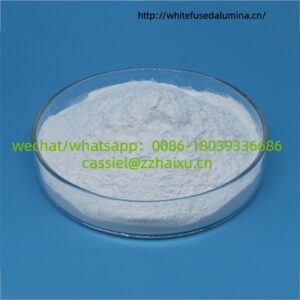
Particle morphology: controllable angular shape, no soft agglomeration, narrow particle size distribution, coarse particles strictly removed
Processing route: electrofusion → crushing → acid washing for sodium removal → multiple magnetic separation → hydraulic classification
Caution: Ordinary refractory-grade high-sodium white fused alumina and brown fused alumina must NOT be used for MLCC. Na and Fe impurities directly cause poor electrical performance and reliability failure.
✅ Particle Size Selection Reference (FEPA / JIS / )
Setter sand for sintering isolation: F220~F600 (D50 ≈30–9 μm). Coarser grades feature good fluidity and air permeability.
Tumbling / chamfering powder: F800~F1500 (D50 ≈6.5–2 μm)