
White fused alumina micropowder is a functional wear-resistant skeleton filler rather than a reinforcing filler. The main reinforcing fillers remain silica and carbon black.
α-Al₂O₃
Mohs hardness :9.0,
It features good acid & alkali resistance and excellent thermal conductivity. It is mainly used in light-colored rubber systems to solve common problems of ordinary fillers, such as insufficient wear resistance, poor corrosion resistance, high temperature rise of rubber rollers, yellowing and black spots.
Functions in Rubber Compounds
- Improve wear resistance: Hard particles disperse in the rubber matrix to form a wear-resistant skeleton. The alumina particles bear shear force during friction and scouring, greatly reducing abrasion loss and extending service life.
- Conduct heat and inhibit thermal aging: Its thermal conductivity is better than carbon black and calcium carbonate. It quickly dissipates frictional heat generated during continuous operation of rubber rollers, lowering roller surface temperature and reducing sticking, softening and thermal aging.
- Good chemical inertness with acid, alkali and oil resistance, suitable for desulfurization and chemical corrosive media.
- High whiteness and low impurities: Strictly controlled Fe₂O₃ and magnetic substances. It prevents yellowing and black spots for light-colored or white rubber, and will not contaminate paper, fabric and food contact materials.
- Slightly increase hardness and modulus at given elongation. Disadvantage: It provides weak reinforcement. High loading will decrease elongation, tear strength and flex resistance, making rubber brittle.
- Silane coating modification is optional: It improves interfacial bonding between powder and rubber, ensures good dispersion, avoids agglomeration and prevents powder falling off and grain shedding.
Typical Application in Rubber Products
- Light-colored wear-resistant rubber rollers (printing, textile, coating, calendering rollers) — Key application Grain size: 2000#–4000# (D50: 3–8 μm) Dosage: 10–25 phr Advantages: Fine powder delivers smooth roller surface without scratching paper, film and fabric; low temperature rise and no material contamination.
- Chemical desulfurization anti-corrosion wear-resistant rubber lining Grain size: 1000#–2000# Dosage: 20–40 phr (max ≤50 phr) Advantages: Superior resistance to acid & alkali scouring from desulfurization slurry, better corrosion resistance than brown fused alumina for chemical corrosive conditions.
- Rubber seals (light-colored oil-resistant anti-corrosion seals) Grain size: 2000#–4000# Dosage: 10–20 phr Notes: Low loading. Elasticity and compression set shall be prioritized; it only serves as auxiliary wear-resistant filler.
- Rubber liners for mud pumps (weakly corrosive chemical slurry) Grain size: 800#–1500# Dosage: 25–40 phr
- Grinding rubber parts, rubber grinding heads Grain size: 1000#–2500#, adjustable by mixing coarse & fine grades Dosage: 15–40 phr, to provide cutting & grinding performance.
- Cover compound of light-colored conveyor belts Grain size: 1500#–2000#, low dosage 10–20 phr.
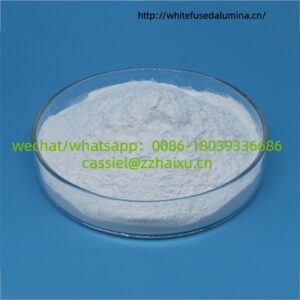
Specifications for Rubber-Grade WFA Micropowder
Al₂O₃ ≥99.3%; Fe₂O₃ ≤0.05%; Na₂O ≤0.3%; Magnetic matter ≤20 ppm; pH 7–9; Silane coating (Si69 / KH560) is preferred.
Brief Comparison with Brown Fused Alumina / Calcined Alumina
- White fused alumina: White, low iron, acid & alkali resistant; for light color and corrosive conditions, higher price, slightly lower toughness.
- Brown fused alumina (corundum sand): Brown, high toughness, good anti-slurry impact, cost-effective; widely used for dark mining lining and conveyor belts.
- Calcined alumina: Lower hardness, poor wear resistance; mainly used for thermal conductive filling, not suitable for heavy friction rubber.